




Table Of Contents
Marketers who rely on AI‑driven search are constantly asked to justify spend while also proving impact on the revenue pipeline. The tension between a predictable, flat fee and a model that scales with results creates uncertainty for budgeting and performance measurement. This article untangles the core differences between subscription pricing and outcome‑based pricing for AI search tools, showing how each aligns with buyer intent signals, first‑party data, and overall marketing intelligence. You will learn how pricing choices affect search visibility, how to map cost structures to revenue‑pipeline attribution, and which factors matter most when you decide which model fits your organization. The guidance is built for a VP of Marketing overseeing demand‑generation and pipeline forecasting in a mid‑market to enterprise B2B software company.
Understanding the two primary pricing models for AI search
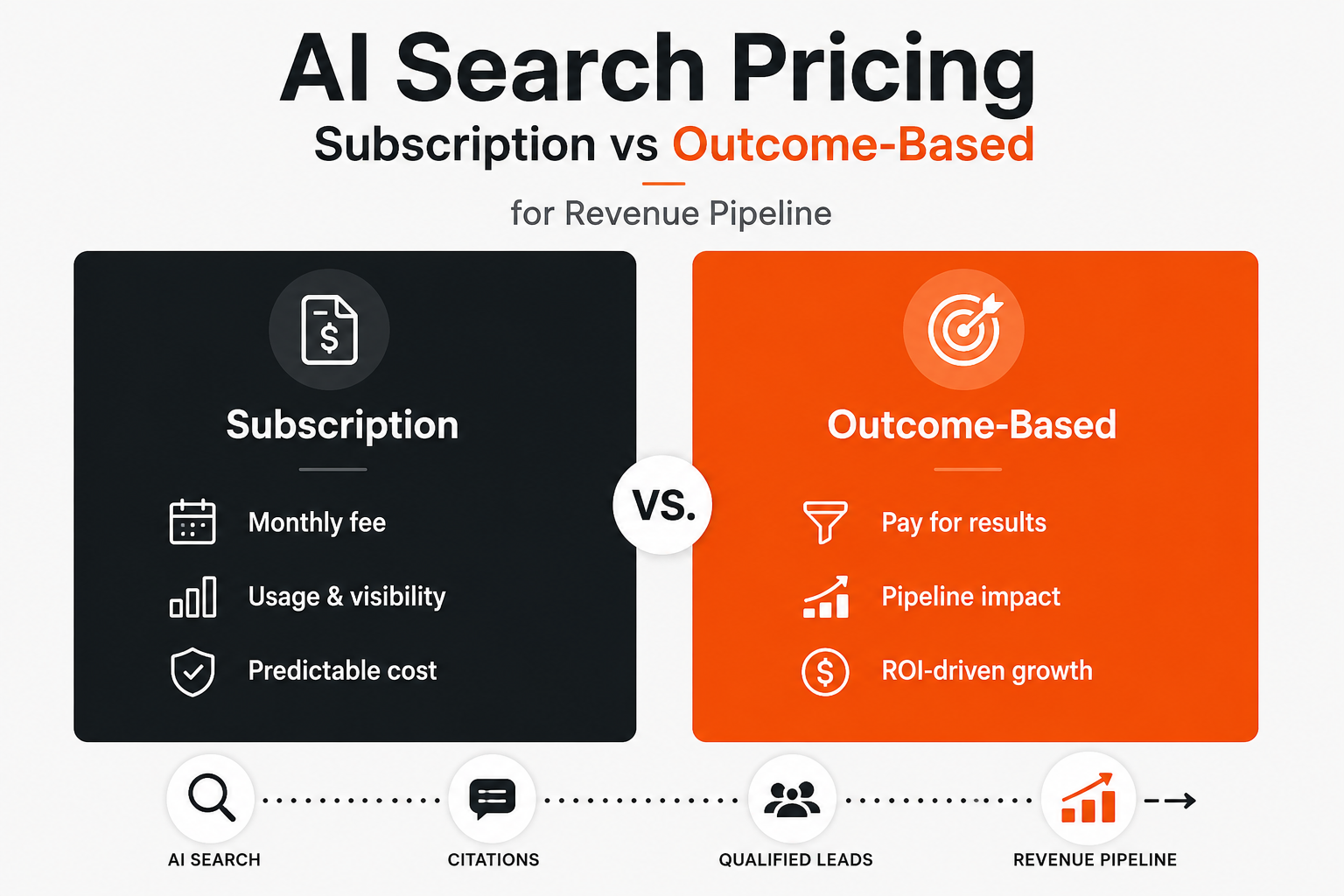
When you evaluate an AI search solution, the first decision is whether the vendor charges a recurring subscription fee or ties cost to measurable outcomes. A subscription model delivers a fixed, recurring charge that simplifies budgeting and aligns with traditional expense planning. In contrast, outcome‑based pricing adjusts fees based on specific results such as qualified leads, pipeline contribution, or revenue impact. "I'm curious on how are you going to charge for this? Is it like going to be just a flat subscription view or are you thinking about like more of this like the up, like up like outcome based pricing type model?" reflects the exact question many senior marketers ask when they first encounter AI search proposals. According to a AI search market size report, the market is expanding rapidly, making the choice of pricing model a strategic lever for controlling spend.
The pricing model also shapes internal alignment. Finance favors subscription certainty, while demand‑generation prefers outcome‑based fees tied to lead quality, reducing later friction.
Both models have distinct characteristics that affect how you plan and measure success. Subscription pricing offers cost predictability, which is valuable for annual budgeting cycles and for teams that prefer a stable expense line. Outcome‑based pricing, however, aligns vendor incentives with your own performance goals, creating a direct link between spend and revenue pipeline outcomes. The table below summarizes the key dimensions of each approach.
| Dimension | Subscription Model | Outcome‑Based Model |
|---|---|---|
| Billing Frequency | Monthly or annual fixed fee | Variable fee tied to results |
| Cost Predictability | High | Variable, depends on performance |
| Alignment with Results | Indirect | Direct, fees scale with pipeline impact |
| Risk Exposure | Vendor bears performance risk | Buyer shares risk based on outcomes |
The table shows that subscription pricing reduces financial uncertainty but may not directly reward the vendor for delivering higher search visibility or buyer intent capture. Outcome‑based pricing, on the other hand, can drive stronger focus on search intent optimization and content intelligence because the vendor’s revenue depends on those metrics.
How pricing impacts revenue‑pipeline attribution
Revenue‑pipeline attribution is the process of linking AI‑generated search interactions to downstream qualified leads and closed‑won deals. The pricing model you choose influences the granularity and reliability of that attribution. With a flat subscription, you typically receive aggregated usage reports that show overall search visibility and click‑through rates but may lack direct correlation to pipeline stages. Outcome‑based contracts often require detailed tracking of buyer intent signals, such as search queries that match high‑value keywords, enabling precise measurement of how AI search contributes to the revenue pipeline.
Accurate attribution also requires clean data. Regularly de‑duplicating CRM records and standardizing keyword taxonomies keep the AI engine fed with reliable buyer signals.
Accurate attribution relies on first‑party data collected from sales calls, CRM notes, and support tickets. When vendors are compensated based on outcomes, they are incentivized to integrate deeper with your data sources, enriching the AI model with real buyer language. This alignment improves the relevance of search results, boosts search visibility, and ultimately feeds more qualified opportunities into the pipeline. A study of competitive intelligence practices notes that firms that connect search data to revenue outcomes see clearer ROI signals.
To maximize the value of your pricing choice, ensure that your measurement framework captures both top‑of‑funnel search visibility metrics and bottom‑of‑funnel pipeline contributions. This dual focus allows you to assess whether the pricing model supports your overall marketing intelligence strategy.
Recommended Read: Best B2B Marketing Automation Platforms 2026: How to Choose & Prove ROI - A deep dive into evaluating automation platforms that complements pricing considerations.
Key factors to evaluate when choosing a model
Choosing between subscription and outcome‑based pricing requires a systematic evaluation of several factors that directly affect budgeting, risk, and performance. First, assess your organization’s tolerance for cost variability. Teams with tight financial controls may favor the predictability of a subscription, while those with flexible budgets may appreciate the upside potential of outcome‑based fees. Second, examine the maturity of your first‑party data infrastructure; robust data pipelines make outcome‑based models more feasible because they enable accurate attribution.
Consider the vendor’s history with similar B2B software firms. Proven success with comparable intent volumes and citation‑focused content lowers risk and supports the chosen pricing model.
Third, consider the strategic importance of buyer intent signals in your AI search strategy. If your content strategy heavily relies on matching precise search intent, an outcome‑based model can push the vendor to fine‑tune prompts and improve content intelligence. Fourth, evaluate contract flexibility. Outcome‑based agreements often include performance thresholds and review periods, which can be advantageous for scaling up or down based on results. Finally, review any hidden costs such as integration, training, or governance that may affect total cost of ownership regardless of the pricing model.
By scoring each factor against your organization’s priorities, you can create a weighted decision matrix that clarifies which model aligns best with your revenue pipeline goals.
Recommended Read: AI Consolidation in Marketing: Streamlining Tools for Quick Decisions - Guidance on consolidating AI tools, helping you understand the broader impact of pricing choices.
Balancing predictability and performance incentives
Predictability and performance incentives are often seen as opposing forces, but a balanced approach can capture the strengths of both pricing models. One strategy is to negotiate a hybrid contract that combines a baseline subscription fee with performance‑based bonuses tied to specific pipeline milestones. This structure provides a stable cost foundation while still rewarding the vendor for delivering higher search visibility and buyer intent capture.
Another approach is to set clear service‑level agreements (SLAs) that define expected outcomes such as a minimum increase in qualified leads or a target improvement in content intelligence metrics. By embedding these SLAs into an outcome‑based contract, you create measurable expectations without sacrificing budgeting certainty. The key is to align incentives with your marketing intelligence goals, ensuring that the vendor’s success is directly linked to your revenue pipeline performance.
Instituting a quarterly business review cadence creates a natural checkpoint where both parties can assess metric trends, adjust incentive thresholds, and reaffirm budget commitments before the next fiscal period begins.
When structuring these agreements, involve cross‑functional stakeholders from finance, legal, and demand‑generation to ensure that the contract terms reflect both financial discipline and growth ambition.
Recommended Read: Is Your Marketing Strategy AI‑Ready? A CEO’s Checklist - A checklist that helps senior leaders evaluate readiness for AI initiatives, including pricing considerations.
Practical steps for making an informed pricing decision
Start by gathering internal data on current search performance, including metrics for search intent alignment, search visibility, and revenue pipeline contribution. Use this baseline to model the financial impact of each pricing option, estimating both fixed costs under a subscription and variable costs under an outcome‑based scenario.
Secure executive sponsorship early by presenting the modeled cost scenarios and expected pipeline impact, ensuring that finance and sales leadership endorse the chosen pricing structure.
Next, engage with potential vendors to request detailed proposals that outline how they will track buyer intent signals and attribute results to the revenue pipeline. Ask for case studies or references that demonstrate successful outcome‑based implementations in similar B2B software environments. Evaluate each proposal against the decision matrix you created earlier, weighting factors such as cost predictability, data integration capabilities, and risk exposure.
Finally, run a pilot program with a short‑term contract that allows you to test the vendor’s ability to deliver on agreed‑upon outcomes. Use the pilot results to refine your attribution model and make a final decision on the long‑term pricing structure.
Aligning pricing with buyer intent and first‑party data
Buyer intent signals are the lifeblood of AI search relevance. They include the language used in sales calls, CRM notes, and support tickets, which inform the prompts that drive AI‑generated answers. When pricing is outcome‑based, vendors have a direct incentive to ingest and analyze these signals, improving the match between user queries and your content. This leads to higher search visibility and more qualified pipeline contributions.
Conversely, a subscription model may not prioritize deep integration with first‑party data, potentially limiting the effectiveness of your AI search strategy. To mitigate this, ensure that any subscription agreement includes clauses for data access and regular performance reviews. By aligning pricing with the richness of your first‑party data, you can enhance content intelligence and drive stronger revenue‑pipeline outcomes.
In practice, map key buyer intent phrases to specific stages of your sales funnel, then track how AI search interactions influence movement between those stages. This mapping provides a clear view of how pricing choices affect the overall marketing intelligence ecosystem.
Common Pitfalls When Transitioning Between Pricing Models
Switching pricing models often reveals hidden gaps. Teams may underestimate the effort to integrate first‑party intent data, causing delayed performance gains and tension with the vendor.
FAQs
1. How do I determine if my organization is ready for outcome‑based AI search pricing?
Readiness starts with a solid first‑party data foundation. Ensure you capture buyer intent signals from sales calls, CRM notes, and support tickets in a structured format. Next, evaluate whether you have the analytics capability to attribute AI search interactions to revenue‑pipeline stages. If those pieces are in place, you can confidently explore outcome‑based contracts that tie fees to measurable results.
2. What hidden costs should I watch for when evaluating AI search pricing models?
Beyond the headline fee, consider integration expenses for connecting the AI platform to your CRM and data warehouses. Training costs for marketing and sales teams to adopt new workflows are also common. Additionally, account for ongoing governance and compliance activities, especially if you are handling first‑party data subject to privacy regulations.
3. Can a hybrid pricing model combine the benefits of both subscription and outcome‑based approaches?
Yes, a hybrid model typically includes a base subscription fee for platform access plus performance‑based bonuses linked to specific pipeline milestones. This structure offers budgeting predictability while still incentivizing the vendor to improve search relevance and buyer intent capture.
4. How does AI search impact overall marketing intelligence and competitive intelligence?
AI search amplifies your ability to surface relevant content quickly, improving search visibility and accelerating the buyer journey. By analyzing query patterns, you also gain insights into competitor positioning and emerging market trends, enriching your competitive intelligence toolkit.
5. What metrics should I track to evaluate the success of my chosen pricing model?
Key metrics include changes in search visibility scores, the volume of qualified leads attributed to AI search, and the contribution of those leads to the revenue pipeline. Additionally, monitor cost‑per‑lead trends and the alignment of AI‑generated content with identified buyer intent signals.
6. How can I ensure contract flexibility while still protecting my budget?
Negotiate clear performance thresholds and review periods within the contract. Include provisions that allow you to adjust the fee structure or switch models if the agreed‑upon outcomes are not met. This approach balances long‑term commitment with the ability to scale based on results.
Conclusion
Choosing the right pricing model for AI search is not a one‑size‑fits‑all decision. By understanding the trade‑offs between subscription predictability and outcome‑based alignment, mapping buyer intent signals, and rigorously attributing search activity to the revenue pipeline, you can make a data‑driven choice that supports both financial discipline and growth ambition. Apply the frameworks and practical steps outlined here to evaluate vendors, negotiate contracts, and ultimately ensure that your AI search investment drives measurable pipeline impact.
Recommended Authority Resources
- Reference: AI Search Engine Market Size, Share | Industry Report, 2033 - Provides comprehensive market sizing and growth forecasts for AI search platforms, supporting strategic budgeting decisions.
- Reference: The Rise of Outcome-Based Pricing in SaaS: Aligning ... - Analyzes adoption trends of outcome‑based pricing in SaaS, offering insights into risk and incentive structures.
Turn Your Content Into AI-Search Winners
Get cited across ChatGPT, Claude & Perplexity — not just ranked on Google.
- Increase AI citations
- Improve answer visibility
- Track brand mentions in LLMs